

With such a surge in social media, it seems as if there’s always a new platform launching every year. For instance, Threads was launched last in 2023 as an extension of Instagram. While researching social media platforms launched in the 21st century, I learned about Orkut, a social media platform that was launched in the early 2000s from the case study, Orkut, in the book, Strategic Social Media: From Marketing to Social Change.
Background
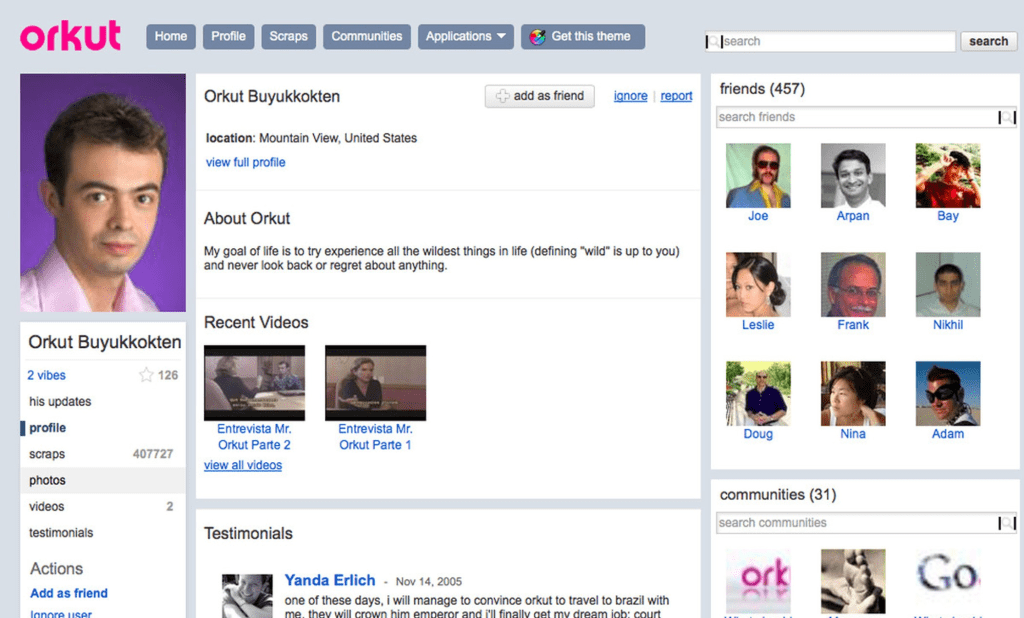
Orkut was launched in 2004 and was owned and operated by Google. The site was named after its creator, a Google employee, Orkut Büyükkökten. The site was initially intended for users to find communities through keyword search, including titles, description, and browsing through other users’ memberships. This is like how you can find almost anything on other social media platforms such as X, Instagram, and Tik Tok through a hashtag or certain descriptions. Orkut was a communication site worked by Google and was predominantly used to meet new and old friends.
Orkut was like most social media sites of today where there are communities, groups, and more. Most users enjoyed the opportunity to find classmates, coworkers, and friends on the site. They also could join groups or communities of online schools, workplaces, and residential street groups. Being a user of the site at the time also showed people that you were technologically savvy.
Orkut Features
The inner workings of Orkut were very simple and meant to be easy for users to navigate through the site and to join communities. Users could interact with others through their scrapbook, add friends, and send messages. Anyone was able to visit profiles of other users unless the visitor was on the user’s “ignore list.” Profile preferences were customizable and could be restricted from people outside of your friend list to see. Initially, Orkut users were able to become fans of their friends and rate them as “cool,” “trustworthy,” or “sexy” on a scale on 1-3, which were aggregated into a percentage. This became a competitive element of communities that spread through friends.

Popularity
Orkut was very popular when it was initially launched. Since it was a Google product, many users were curious to see how the platform worked since Google had a strong reputation and brand awareness. In the first months, Orkut has over 50,000 communities that were established. After a year, the number of communities grew to 1,500,000. The peak popularity of Orkut was in 2012 when the social media platform had thirty million users. It was particularly popular among technology workers and students who used the platform for engagement, connectivity, and marketing purposes.
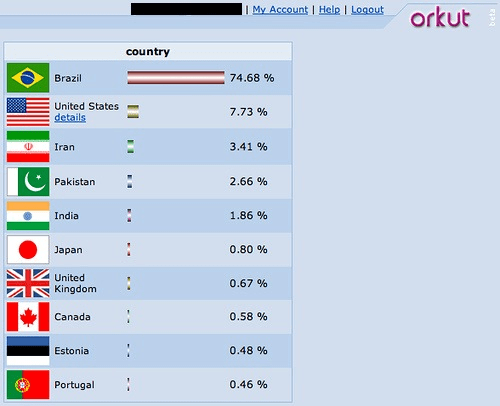
Orkut was extremely successful in the Brazilian social media market. This comes as no surprise as Brazilians classify themselves as a community-oriented group, which is what Orkut created for its users. The country was big on social media and digital media exploration. The site was the first full service social networking platform to be available in Brazil. It was ranked as the third most accessed internet domain in Brazil with its peak popularity in 2008 (Recuero, 2009). Ninety percent of page views on Orkut were accessed by Brazilian users, and by over fifty percent of traffic on the platform was from Brazil. For platforms to be successful in Brazil, it’s pertinent that users can blog, engage with others, and incorporate online video into marketing campaigns, which Orkut provided. With this much success from the Brazilian market, Orkut was eventually moved to be fully managed and operated from Belo, Horizonte, Brazil.
Orkut Shutdown
Orkut remained a market leader for seven years, but it eventually had several issues that led to the platform’s demise. Many users complained of how slow the speed was on the site. As the number of users increased on the platform, it slowed down the Orkut servers. It also became increasingly harder to keep up with competing social media platforms such as Facebook, FriendFeed, Myspace, and Instagram. Orkut eventually began undergoing multiple redesigns to introduce new features, which didn’t seem to engage or enhance the user experience. For example, the complexity of the navigation of the site became too much for users, many of them switched to Facebook for its simplicity. Orkut came to an end in 2014 when Google shut down the platform.
Key Takeaways
The rise and fall of Orkut show that the platform couldn’t keep up with the evolution of social media and user preferences. Orkut carried a high prestige factor, and users loved the aspect of being a part of one or many communities, while interacting with friends and more. Its demise was a direct result of Orkut no longer meeting the needs of its audience. Their users eventually switched to other platforms, which shows how important it is for marketers and companies to keep up with the demands and trends of the world to make their customers happy.
Today, Orkut is attempting to revive its success from the early 2000s with the platform, Hello. Hello, is owned by the Hello Network and is a social media platform that was launched in 2016. Instead of it being friend – connection focused, the platform is more an interest-based network, similar to Pinterest.
References
Gannes, L. (2014, June 30). Flashing back to 2004 as Orkut fades away a decade later. Vox. https://www.vox.com/2014/6/30/11628448/flashing-back-to-2004-as-orkut-fades-away-a-decade-later
Orkut founder launches hello, a social network focused on Your passions | venturebeat. (n.d.). https://venturebeat.com/social/orkut-founder-launches-hello-a-social-network-focused-on-your-passions/
Jpond. (2021, July 15). Social Media in South America: Orkut & brazil. Connected Learning Alliance. https://clalliance.org/blog/social-media-in-south-america-orkut-brazil/#:~:text=According%20to%20data%20recently%20released%20by%20Ibope%2FNetRatings%20%28all,the%20third%20most%20accessed%20Internet%20domain%20in%20Brazil
Mahoney, L. M., & Tang, T. (2024). Strategic social media: From marketing to social change. Wiley-Blackwell.
2 responses to “Orkut: Social Media Lost, but Never Forgotten”
-
Hey Lashanda!
I enjoyed reading your blog post. I especially appreciated how you referenced new social media platforms, such as Threads, and pointed out that searching through keywords is now used on other platforms like Instagram, X, and TikTok, as well as hashtags. It was interesting to learn that Orkut was one of the pioneers in using this search method. Orkut has many communities and has been successful in Brazilian culture.
Furthermore, it was fascinating to learn that while the company started strong, it eventually needed to catch up with user preferences and the ever-evolving pace of technology. I couldn’t agree more with you that companies and marketers must keep up with what attracts their users and makes them happy. This knowledge could have helped Orkut thrive further than they did.Thank you for sharing!
KyleeLikeLike
-
Great post Lashonda, I enjoyed reading your blog. I love the overall look and pink font that coincident with the Orkut logo. You transitioned your points from one topic to the next very well. I wonder how successful Orkut would’ve been if they were able to adapt.
Orkut may have faded into obscurity, but its impact on shaping our online social experiences is undeniable. This post offers a fascinating look back at the rise and fall of one of the earliest social networking platforms.
LikeLike

 S Holmes
  Lashanda Shepherd
Leave a comment